PINNs: grad-div system 2D
Solves a grad-div system in 2D with Dirichlet boundary conditions using a PINN.
\[\begin{split}\left\{\begin{array}{rl} -\nabla (\nabla \cdot u) + u & = f \text{ in } \Omega \times M \\
u & = g \text{ on } \partial \Omega \times M\end{array}\right.\end{split}\]
where \(u: \Omega \times M \to \mathbb{R}^2\) is the unknown function, \(\Omega \subset \mathbb{R}^2\) is the spatial domain and \(M \subset \mathbb{R}\) is the parametric domain and \(f: \Omega \times M \to \mathbb{R}^2\).
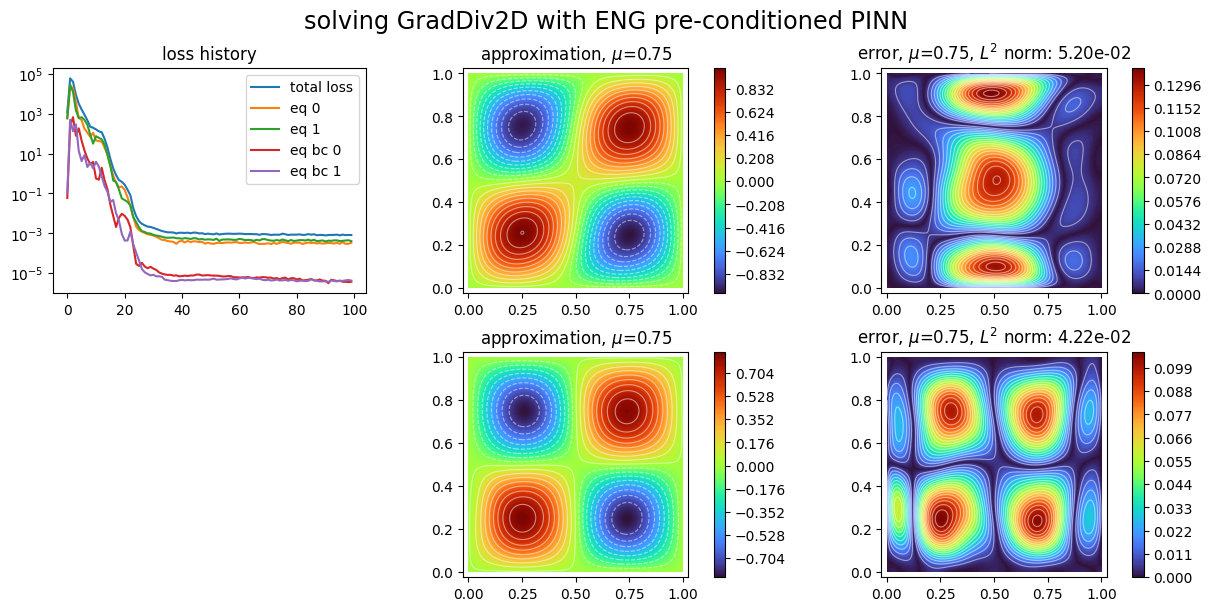
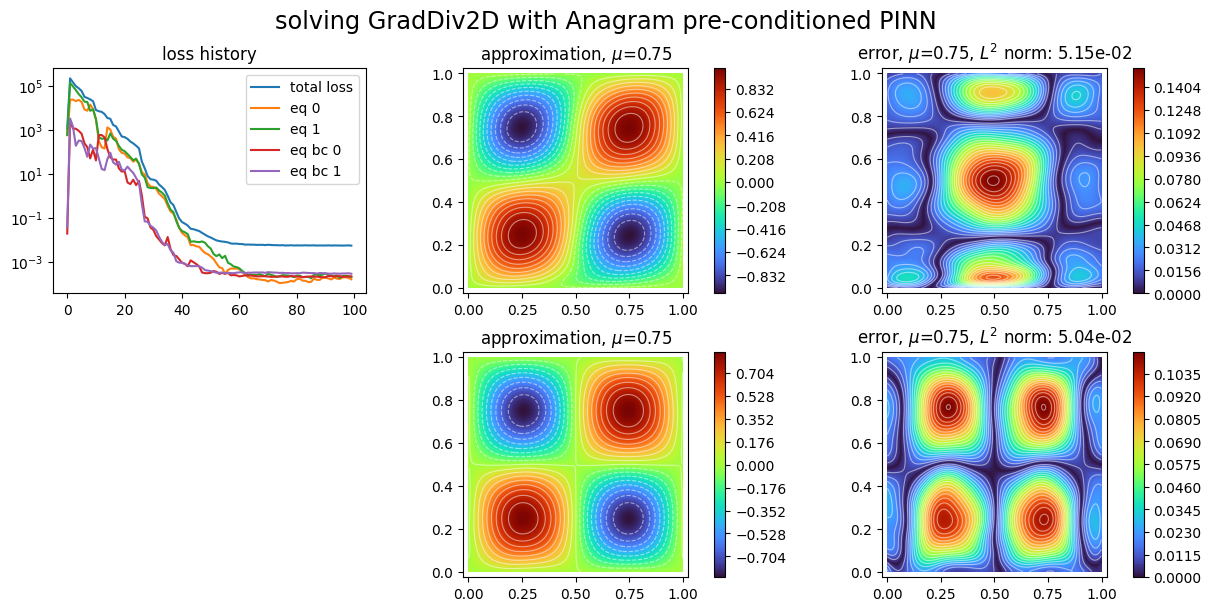
The equation is solved on a square domain with PINNs with energy natural gradient preconditioning and PINNs with ANaGRAM preconditioning.
Weak and strong boundary conditions are used.
[1]:
from typing import Callable, Tuple

import matplotlib.pyplot as plt
import torch

from scimba_torch.approximation_space.abstract_space import AbstractApproxSpace
from scimba_torch.approximation_space.nn_space import NNxSpace
from scimba_torch.domain.meshless_domain.domain_2d import Square2D
from scimba_torch.integration.monte_carlo import DomainSampler, TensorizedSampler
from scimba_torch.integration.monte_carlo_parameters import UniformParametricSampler
from scimba_torch.neural_nets.coordinates_based_nets.mlp import GenericMLP
from scimba_torch.numerical_solvers.elliptic_pde.pinns import (
    NaturalGradientPinnsElliptic,
)
from scimba_torch.plots.plots_nd import plot_abstract_approx_spaces
from scimba_torch.utils.scimba_tensors import LabelTensor, MultiLabelTensor
from scimba_torch.utils.typing_protocols import VarArgCallable

torch.manual_seed(0)

class GradDiv2D:
    def __init__(
        self,
        space: AbstractApproxSpace,
        f: Callable,
        g: Callable,
        **kwargs,
    ):
        self.space = space
        self.f = f
        self.g = g

        self.linear = True
        self.residual_size = 2
        self.bc_residual_size = 2

    def grad(
        self,
        w: torch.Tensor | MultiLabelTensor,
        y: torch.Tensor | LabelTensor,
    ) -> torch.Tensor | Tuple[torch.Tensor, ...]:
        return self.space.grad(w, y)

    def rhs(
        self, w: MultiLabelTensor, x: LabelTensor, mu: LabelTensor
    ) -> Tuple[torch.Tensor]:
        return self.f(x, mu)

    def bc_rhs(
        self, w: MultiLabelTensor, x: LabelTensor, n: LabelTensor, mu: LabelTensor
    ) -> Tuple[torch.Tensor]:
        return self.g(x, mu)

    def operator(
        self, w: MultiLabelTensor, xs: LabelTensor, mu: LabelTensor
    ) -> Tuple[torch.Tensor]:
        x, y = xs.get_components()
        u, v = w.get_components()
        u_x, u_y = self.grad(u, xs)
        u_xx, u_xy = self.grad(u_x, xs)

        v_x, v_y = self.grad(v, xs)
        v_yx, v_yy = self.grad(v_y, xs)

        return u_xx + v_yx + u, u_xy + v_yy + v

    def restrict_to_component(self, i: int, func):
        return lambda *args: func(*args)[i : i + 1, ...]

    def functional_operator(
        self,
        func: VarArgCallable,
        x: torch.Tensor,
        mu: torch.Tensor,
        theta: torch.Tensor,
    ) -> torch.Tensor:
        uv_x = func(x, mu, theta)
        grad_u = self.restrict_to_component(0, torch.func.jacrev(func, 0))
        grad_v = self.restrict_to_component(1, torch.func.jacrev(func, 0))
        hessian_u = torch.func.jacrev(grad_u, 0)(x, mu, theta).squeeze()
        hessian_v = torch.func.jacrev(grad_v, 0)(x, mu, theta).squeeze()
        res = hessian_u[..., 0] + hessian_v[..., 1] + uv_x
        return res

    # Dirichlet conditions
    def bc_operator(
        self, w: MultiLabelTensor, x: LabelTensor, n: LabelTensor, mu: LabelTensor
    ) -> Tuple[torch.Tensor]:
        u, v = w.get_components()
        return u, v

    def functional_operator_bc(
        self,
        func: VarArgCallable,
        x: torch.Tensor,
        n: torch.Tensor,
        mu: torch.Tensor,
        theta: torch.Tensor,
    ) -> torch.Tensor:
        return func(x, mu, theta)


def exact_solution(xs: LabelTensor, mu: LabelTensor) -> torch.Tensor:
    x, y = xs.get_components()
    alpha = mu.get_components()
    return torch.cat(
        (
            torch.sin(2.0 * torch.pi * x) * torch.sin(2.0 * torch.pi * y),
            alpha * torch.sin(2.0 * torch.pi * x) * torch.sin(2.0 * torch.pi * y),
        ),
        dim=-1,
    )


def f_rhs(xs: LabelTensor, mu: LabelTensor) -> Tuple[torch.Tensor]:
    x, y = xs.get_components()
    alpha = mu.get_components()

    PI = torch.pi
    cos_x = torch.cos(2.0 * PI * x)
    cos_y = torch.cos(2.0 * PI * y)
    sin_x = torch.sin(2.0 * PI * x)
    sin_y = torch.sin(2.0 * PI * y)

    f1 = (1 - 4 * PI**2) * sin_x * sin_y + 4 * PI**2 * alpha * cos_x * cos_y
    f2 = (1 - 4 * PI**2 * alpha) * sin_x * sin_y + 4 * PI**2 * cos_x * cos_y
    return f1, f2


def f_bc(xs: LabelTensor, mu: LabelTensor) -> Tuple[torch.Tensor]:
    x, _ = xs.get_components()
    return torch.zeros_like(x), torch.zeros_like(x)


bc_weight = 10.0

domain_mu = [(0.75, 0.75)]
domain_x = Square2D([(0.0, 1), (0.0, 1)], is_main_domain=True)

sampler = TensorizedSampler(
    [DomainSampler(domain_x), UniformParametricSampler(domain_mu)]
)
ENG preconditioned PINN, weak boundary conditions
[2]:
space = NNxSpace(2, 1, GenericMLP, domain_x, sampler, layer_sizes=[64])
pde = GradDiv2D(space, f_rhs, f_bc)

pinns = NaturalGradientPinnsElliptic(
    pde,
    bc_type="weak",
    bc_weight=bc_weight,
    one_loss_by_equation=True,
    matrix_regularization=1e-6,
)

pinns.solve(epochs=100, n_collocation=3000, n_bc_collocation=1000, verbose=False)
Training: 100%|||||||||||||||||| 100/100[00:08<00:00] , loss: 1.2e+03 -> 8.1e-04
ANaGRAM preconditioned PINN, weak boundary conditions
[3]:
space2 = NNxSpace(2, 1, GenericMLP, domain_x, sampler, layer_sizes=[64])
pde2 = GradDiv2D(space2, f_rhs, f_bc)

pinns2 = NaturalGradientPinnsElliptic(
    pde2,
    bc_type="weak",
    bc_weight=bc_weight,
    one_loss_by_equation=True,
    ng_algo="ANaGRAM",
    svd_threshold=5e-2,
)

pinns2.solve(epochs=100, n_collocation=3000, n_bc_collocation=1000, verbose=False)
Training: 100%|||||||||||||||||| 100/100[00:16<00:00] , loss: 1.2e+03 -> 5.9e-03
[4]:
plot_abstract_approx_spaces(
    pinns.space,
    domain_x,
    domain_mu,
    loss=pinns.losses,
    error=exact_solution,
    draw_contours=True,
    n_drawn_contours=20,
    title="solving GradDiv2D with ENG preconditioned PINN",
)

plt.show()

plot_abstract_approx_spaces(
    pinns2.space,
    domain_x,
    domain_mu,
    loss=pinns2.losses,
    error=exact_solution,
    draw_contours=True,
    n_drawn_contours=20,
    title="solving GradDiv2D with Anagram preconditioned PINN",
)

plt.show()
Strong boundary conditions
[5]:
def post_processing(inputs: torch.Tensor, xs: LabelTensor, mu: LabelTensor):
    x, y = xs.get_components()
    # _ = mu.get_components()
    phi = x * (x - 1.0) * y * (y - 1.0)
    return inputs * phi


def functional_post_processing(
    func, x: torch.Tensor, mu: torch.Tensor, theta: torch.Tensor
) -> torch.Tensor:
    phi = x[0] * (x[0] - 1.0) * x[1] * (x[1] - 1.0)
    return func(x, mu, theta) * phi
ENG preconditioned PINN, strong boundary conditions
[6]:
space3 = NNxSpace(2, 1, GenericMLP, domain_x, sampler, layer_sizes=[64], post_processing=post_processing)
pde3 = GradDiv2D(space3, f_rhs, f_bc)

pinns3 = NaturalGradientPinnsElliptic(
    pde3,
    bc_type="strong",
    one_loss_by_equation=True,
    matrix_regularization=1e-6,
    functional_post_processing=functional_post_processing,
)

pinns3.solve(epochs=50, n_collocation=3000, verbose=False)
Training: 100%|||||||||||||||||||| 50/50[00:05<00:00] , loss: 1.2e+03 -> 1.7e-03
Anagram preconditioned PINN, strong boundary conditions
[7]:
space4 = NNxSpace(2, 1, GenericMLP, domain_x, sampler, layer_sizes=[64], post_processing=post_processing)
pde4 = GradDiv2D(space4, f_rhs, f_bc)

pinns4 = AnagramPinnsElliptic(
    pde4,
    bc_type="strong",
    one_loss_by_equation=True,
    svd_threshold=5e-3,
    functional_post_processing=functional_post_processing,
)

pinns4.solve(epochs=200, n_collocation=3000, verbose=False)
---------------------------------------------------------------------------
NameError                                 Traceback (most recent call last)
Cell In[7], line 4
      1 space4 = NNxSpace(2, 1, GenericMLP, domain_x, sampler, layer_sizes=[64], post_processing=post_processing)
      2 pde4 = GradDiv2D(space4, f_rhs, f_bc)
----> 4 pinns4 = AnagramPinnsElliptic(
      5     pde4,
      6     bc_type="strong",
      7     one_loss_by_equation=True,
      8     svd_threshold=5e-3,
      9     functional_post_processing=functional_post_processing,
     10 )
     12 pinns4.solve(epochs=200, n_collocation=3000, verbose=False)

NameError: name 'AnagramPinnsElliptic' is not defined
[ ]:
plot_abstract_approx_spaces(
    pinns3.space,
    domain_x,
    domain_mu,
    loss=pinns3.losses,
    error=exact_solution,
    draw_contours=True,
    n_drawn_contours=20,
    title="solving GradDiv2D with ENG preconditioned PINN",
)

plt.show()

plot_abstract_approx_spaces(
    pinns4.space,
    domain_x,
    domain_mu,
    loss=pinns4.losses,
    error=exact_solution,
    draw_contours=True,
    n_drawn_contours=20,
    title="solving GradDiv2D with Anagram preconditioned PINN",
)

plt.show()
[ ]: