ScimBa

pipeline status coverage report Latest Release Doc

Scimba is a Python library that implements varying Scientific Machine Learning (SciML) methods for PDE problems, as well as tools for hybrid numerical methods.

The current version of the code solves parametric PDEs using various nonlinear approximation spaces such as neural networks, low-rank approximations, and nonlinear kernel methods. These methods:

  • can handle complex geometries generated via level-set techniques and mappings, including sub-volumetric and surface domains;

  • support function projections as well as elliptic, time-dependent, and kinetic parametric PDEs;

  • are compatible with both space–time algorithms (PINN, Deep Ritz) and time-sequential ones (discrete PINNs, neural Galerkin and neural semi-Lagrangian schemes).

To achieve this, the code provides several optimization strategies, including:

  • Adam, L-BFGS, SS-BFGS and SS-Broyden;

  • natural gradient methods (for neural network-based models);

  • hybrid least-squares approaches.

The current version of Scimba relies on a PyTorch backend. A JAX version is under development.

Documentation: https://www.scimba.org/

Code repository: https://gitlab.com/scimba/scimba/

Install

uv is the preferred tool to install scimba, but you can also use pip. In any case, it is strongly recommended to isolate your installation in a virtual environment (uv does this for you).

If your project is handled by a pyproject.toml:

uv init
uv add scimba

otherwise:

uv pip install scimba
pip install scimba

Note

If you are using an AMD GPU, you need to set the appropriate index URL to install the PyTorch ROCm version prior to installing scimba.

export UV_EXTRA_INDEX_URL="https://download.pytorch.org/whl/rocm6.4"
export PIP_INDEX_URL="https://download.pytorch.org/whl/rocm6.4"

Learning ScimBa

If you are new to Physics Informed Neural Networks, a good start may be to follow this course: https://rimbach.gitlabpages.inria.fr/fabrique-ton-pinns.

In the meantime, here is a gallery of tutorials and examples to get you started with ScimBa.

Tutorials

Each tutorial is a single Jupyter notebook that helps you get started with Scimba.

2D Laplacian tutorial
2D Laplacian Problems

Solve 2D Laplacian problems with Dirichlet boundary conditions.

Scimba basics I: approximation of the solution of a 2D Laplacian
Natural gradients preconditioners tutorial
Natural Gradients Preconditioners

Setup an equation for applying preconditioners.

Scimba basics II: Natural gradient preconditioners
Domain tutorial
Defining Domains

Learn how to define and work with computational domains.

Creating meshless domains
Defining models tutorial
Defining Models

Learn how to define physical models and PDEs in Scimba for different problem types.

Defining a physical model
Projection tutorial
Projection of functions

Learn how to approximate a function given as an evaluation procedure with a network based approximation space.

Projection of a function on an approximation space.
2D Laplacian tutorial
Saving and loading PINNs

Save and load PINNs.

Saving and loading PINNs
Strong BC tutorial
Strong Boundary Conditions

Implementation of strong boundary conditions in 2D problems.

Strong boundary conditions
Mixed BC tutorial
Mixed Boundary Conditions

Handling mixed boundary conditions.

Imposing mixed boundary conditions
Time discrete tutorial
Time Discrete Methods

Explore time discretization methods for temporal PDEs.

Using Time-Discrete Schemes
Scimba Optimizers
Scimba optimizers

Scimba optimizers how to.

Scimba Optimizers
Scimba Losses
PINN’s losses

How to define and tune losses and losses weights.

Losses in Scimba PINNs

Examples

Each example is a single Jupyter notebook.

viscous Euler example
1D viscous Burger equation

Solves the viscous Burgers advection equation in 1D using a PINN.

PINNs: viscous Burgers 1D
inhomogenous Helmholtz example
Inhomogenous Helmholtz equation

Solves an inhomogenous Helmholtz equation using a PINN and a MLP with multi-scale Fourier features.

PINNs: Inhomogeneous Helmholtz equation
linearized Euler example
Linearized Euler system

Solves the linearized Euler system using a PINN.

PINNs: linearized Euler 1D
grad div example
Grad div system 2D

Solves a 2D grad div system with PINNs.

PINNs: grad-div system 2D
div A grad u example
Div A grad u system 2D

Solves a 2D div A grad u system with the deep Ritz method.

Deep Ritz: div A grad u 2D
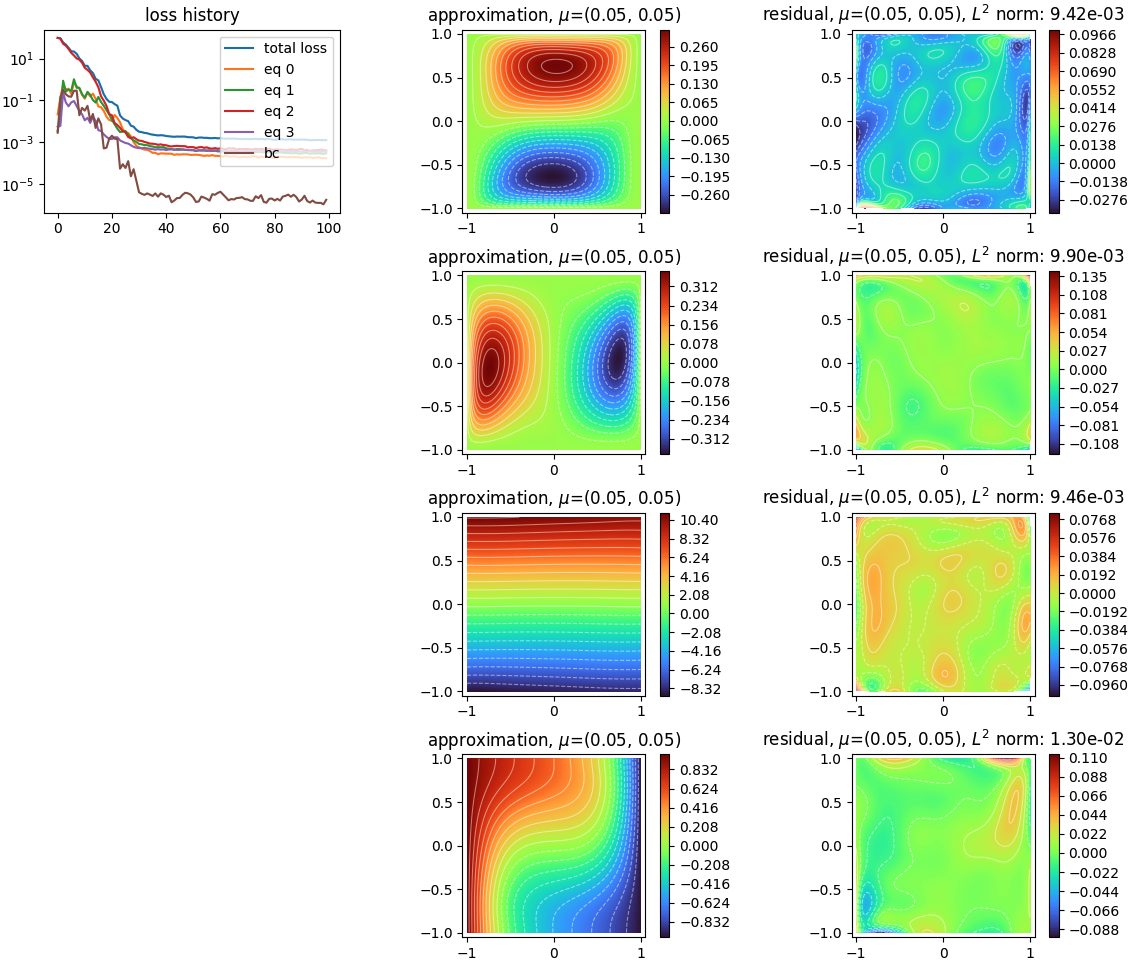
Navier Stokes example
Navier Stokes system of equations

Solves a 2D Navier Stokes system with PINNs.

PINNs: Navier Stokes equation
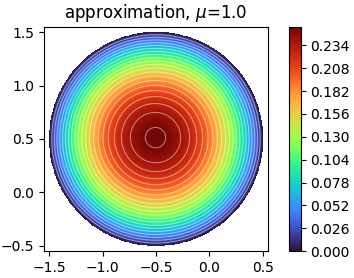
2D laplacian disk example
2D laplacian disk

Solves a 2D laplacian on a disk with the deep Ritz method.

Deep Ritz: 2D laplacian on a disk
pendulum flow example
Pendulum flow

Learns the flow of a pendulum ODE with different training strategies.

Flows: pendulum
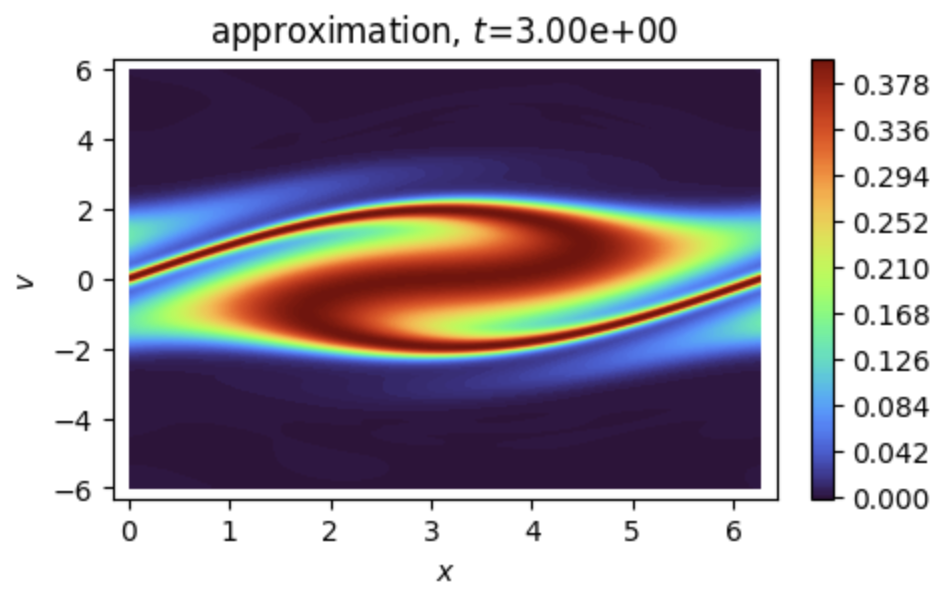
kinetic Vlasov equation example
Kinetic Vlasov equation

Solves a kinetic Vlasov equation in 1D with neural Semi-Lagrangian approach.

Time discrete: kinetic Vlasov in 1D
rotating transport equation example
Rotating transport equation

Solves a rotating transport equation in 2D with neural Galerkin approach.

Time discrete: rotating transport
2D heat equation example
2D heat equation

Solves a 2D heat equation with discrete pinns using implicit scheme.

Time discrete: heat equation
transport in cylinder example
Transport equation in a cylinder

Solves a transport equation in a cylinder with neural Semi-Lagrangian approach.

Time discrete: transport in a cylinder
3D level-set function example
Advection of a 3D level-set function

Solves the advection of a 3D level-set function with neural Semi-Lagrangian approach.

Time discrete: advection of a 3D level-set function
Learning a Signed Distance Function
Learning the Signed Distance Function of a shape

Learns the Signed Distance Function of a shape given as a file of points on its contour.

Learning the Signed Distance Function of a shape

A complete list of script examples is available in the examples/ directory of the repository.

Scimba API documentation

Basic configuration

Please refer to the basic configuration page for an overview of scimba_torch global parameters.

Available Packages

scimba_torch.approximation_space

Defines the approximation space and its components.

scimba_torch.domain

Defines mesh-based and meshless domains.

scimba_torch.flows

Various numerical integrators for ODEs.

scimba_torch.integration

Integration methods for volumetric and surfacic domains.

scimba_torch.geometry

A module implementing tools for geometry learning.

scimba_torch.neural_nets

Defines neural networks.

scimba_torch.numerical_solvers

Defines numerical solvers.

scimba_torch.optimizers

Scimba optimizers and losses.

scimba_torch.physical_models

Defines physical models.

scimba_torch.plots

Plot utilities.

scimba_torch.utils

Utility functions and classes.

Development